
We’re proud of our own industrial engineer Nick Knotts for always looking for innovative ways to make the castings we produce… better.
Nick was awarded the Founders’ Choice Award for his research paper on the effects of mold wash drying methods on the formation of gasses and inclusions.
He presented the paper at the Steel Founders’ Society of America’s Technical and Operating conference.
Inspiration for the mold wash drying research
Nick’s research was inspired by past experiences at Temperform, as well as some issues Lawton Standard has seen across the family of companies.
But that wasn’t the only inspiration for this award-winning research paper. “The specific project was inspired by a couple of researchers that went before me,” said Knotts. “On top of that, generally for me, it’s a desire to deeply understand all of the variables that effect the outcome of the casting process.”
Nick also presented some work on penetration vs. thickness in mold washes at the 2024 AFS Metalcasting Congress in Milwaukee. You can read his research on mold wash penetration vs. thickness right here.
The focus of Nick Knotts’ research on mold wash drying
Nick studied both water-based and solvent-based washes in his research.
“There is a two-part process here in my research,” said Knotts.
The first part is the “loss on ignition after drying,” LOIAD testing, which gives us a quantifiable number as the amount of “stuff,” gas mostly, that is coming off the wash at a given temperature when it’s held there for a given time.
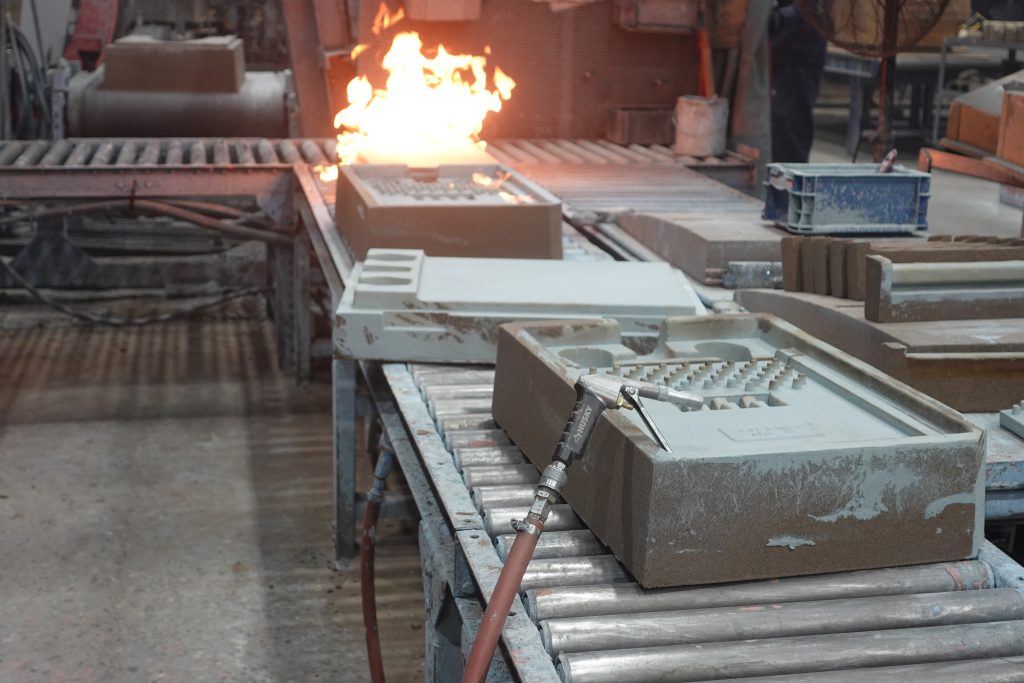
The second part involved a qualitative study using test castings.
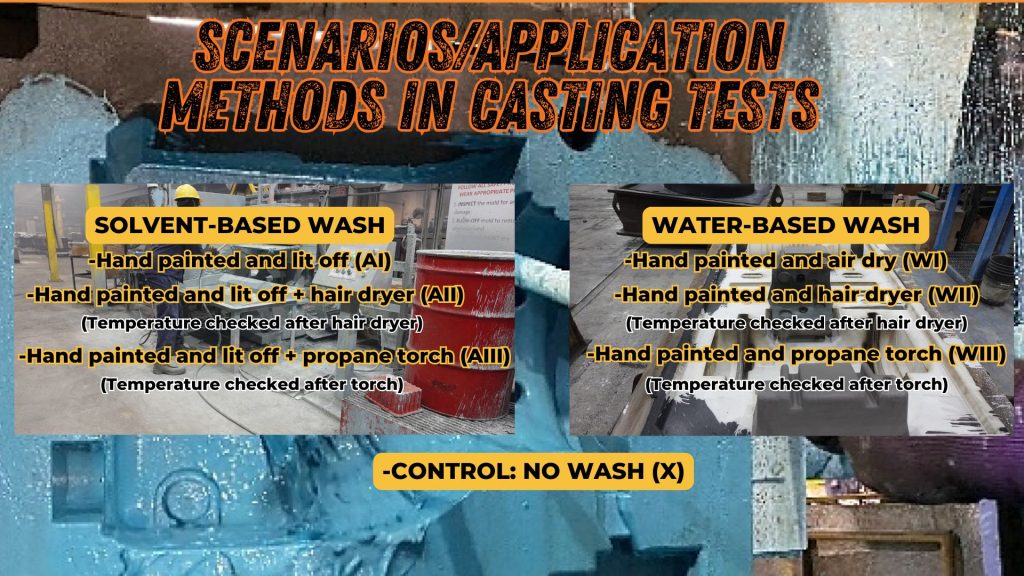
“What I did with the test casting is actually took the combinations of wash I tested in the LOIAD testing and then I applied those to the molds and poured metal into them,” said Knotts.
Here is a list of the scenarios/application methods Knotts used in his casting tests, as well as the marking on each casting.
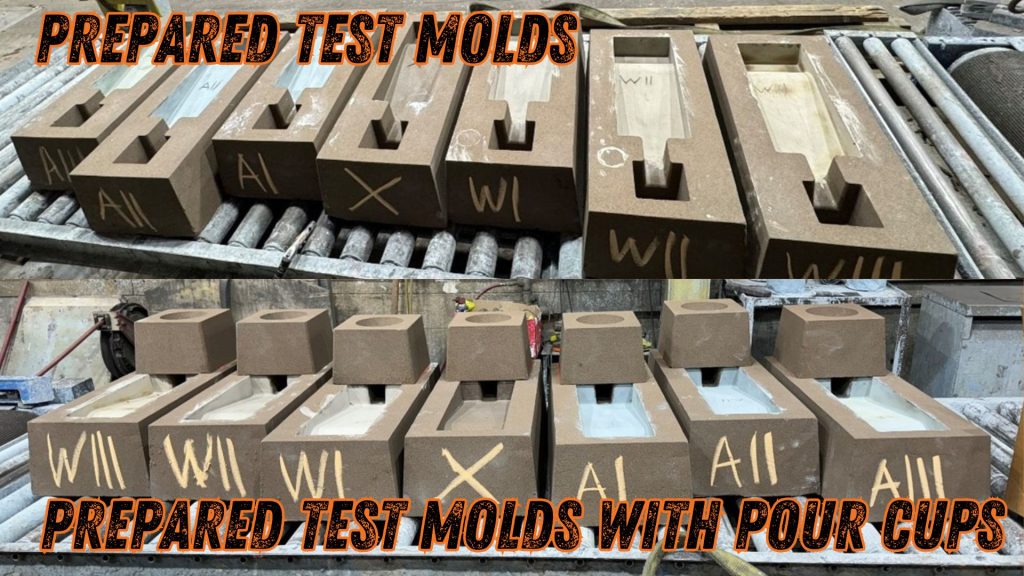
The casting test molds were lined up and only the casting itself was coated in the wash.
Pour cups were glued to the test molds.
The team looked underneath each of the pour cups to ensure that no core paste had seeped into the well.
The results of the research
So what did the casting tests show when it comes to mold wash drying?
Surface conditions of the castings
The “X” casting, which had no wash on it, was by far the best casting during the pour.
The rest of the castings were largely indistinguishable from each other by surface condition alone.
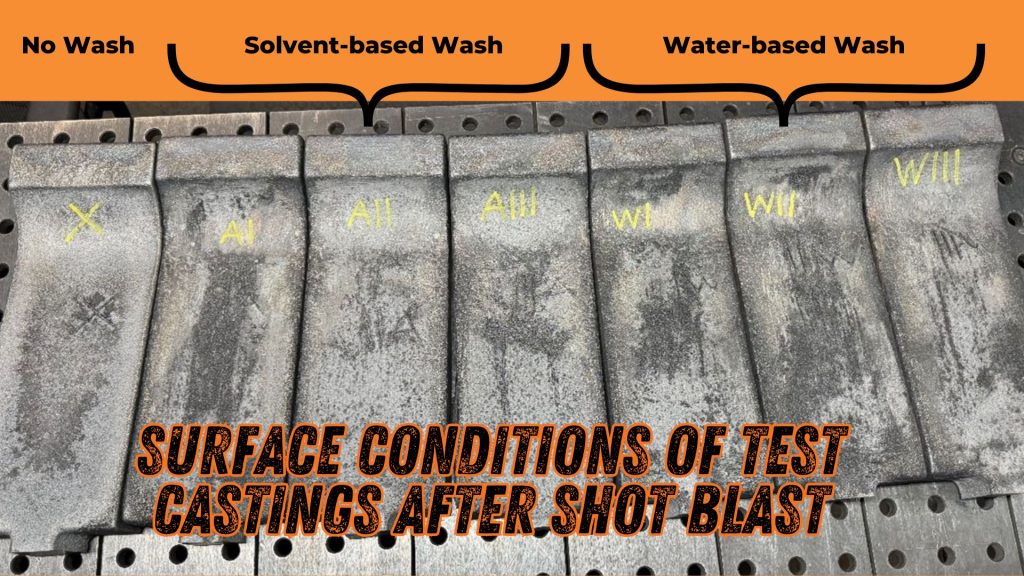
“There isn’t necessarily a method that works best, but there are important variables to control,” said Knotts. “I can’t tell you there is one be all, end all way to dry the mold wash to reduce the quantity of gas that it could potentially form.”
Knotts went on to say that for water-based washes, the important part is the amount of time you hold the wash at a given temperature during the drying process, so long as the temperature is high enough.
As for solvent-based washes, Knotts said “I can tell you that more temperature is better. Time does also play a role, but not as much as water-based washes.”
“One of the conclusions we made is that it’s significantly harder, however not impossible, to properly dry a water-based wash,” said Knotts. “It is significantly easier to dry a solvent-based wash.”
Subsurface gas porosity
When it comes to subsurface gas porosity, the controlled no-wash “X” and all the solvent-based washes came out with no gas or porosity inside the sectioned pieces.
The castings were sectioned through the chunky area near the end of the casting to check for these results.
While “X’ and the solvent-based washes had no visible difference, there was a vast difference with the water-based wash castings.
The water-based wash sections had a dramatic quantity of gas in the section and it didn’t matter what the drying method was.
Why do foundries use mold washes?
You may be asking why foundries use mold washes if the casting with no wash produced better results in the tests?
“The reason for a wash is to prevent burn-on sand basically,” said Knotts. “So what you’re actually doing is you are applying a liquid refractory coating to the mold. It’s similar to what we line our ladles and furnaces with. That refractory protects the components of the furnace and ladle from the molten metal. The wash does the exact same thing, but protecting the sand.”
The wash is applied to the mold in the form of a liquid.

In the end, you have to find a way to get the liquid out and only leave behind the refractory. Knotts said it is not easy to get the liquid out. Another concern is that different wash manufacturers may have different chemicals and components added to the wash.
“Some think a good wash is something that looks good on the mold,” said Knotts. “Well, I don’t really care how it looks on the mold, I care how it interacts with the steel.”
Future research on mold washes
“For me, this paper, while it answered some questions, raised a lot more questions in terms of wash and how it interacts with the metal we’re pouring into our molds,” said Knotts.
“We still don’t have a great understanding of how wash influences the metal when they meet in the pouring process.”
Knotts has some ideas on future research into mold washes. He would like to play around with the different wash thicknesses and baume levels. He wants to see how those thicknesses affect the ability of the wash to form gasses both quantitatively in an LOIAD test and also qualitatively in pouring test castings.
“I’d also like to test different wash manufacturers against each other,” said Knotts. He would like to see if they have substantially different washes in terms of performance in a test casting.
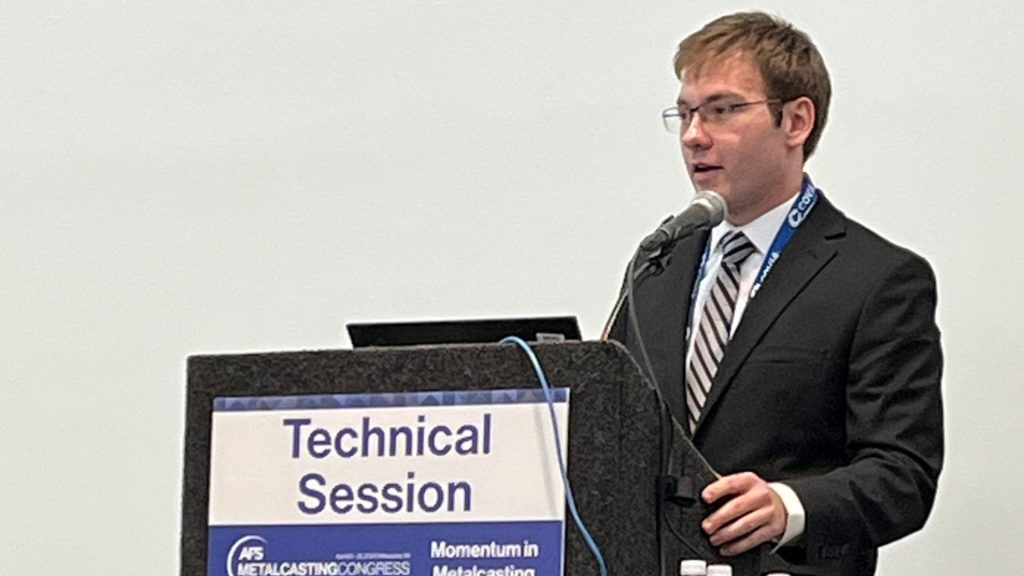
Knotts added that one last thing he’d like to further research similar to what he presented at the 2024 AFS Metalcasting Congress’ technical session. That is to look at alumina-based wash and zircon-based wash side by side to see how they compare.
“I definitely want to do more research to understand the interaction of washes and metal during pouring. We can then leverage that research to make better castings, more free of gas, more free of oxidation and more free of inclusions,” ended Knotts.
Contact Temperform and Lawton Standard today
Congrats again to Nick for winning the SFSA Founders’ Choice Award for his research on mold wash drying methods.
You can count on Temperform to produce high-quality steel castings for you, always striving for innovation and continuous improvement.
And for high-quality iron castings, turn to the Lawton Standard family of companies for your needs.
Call us today to speak to a steel or iron expert.